

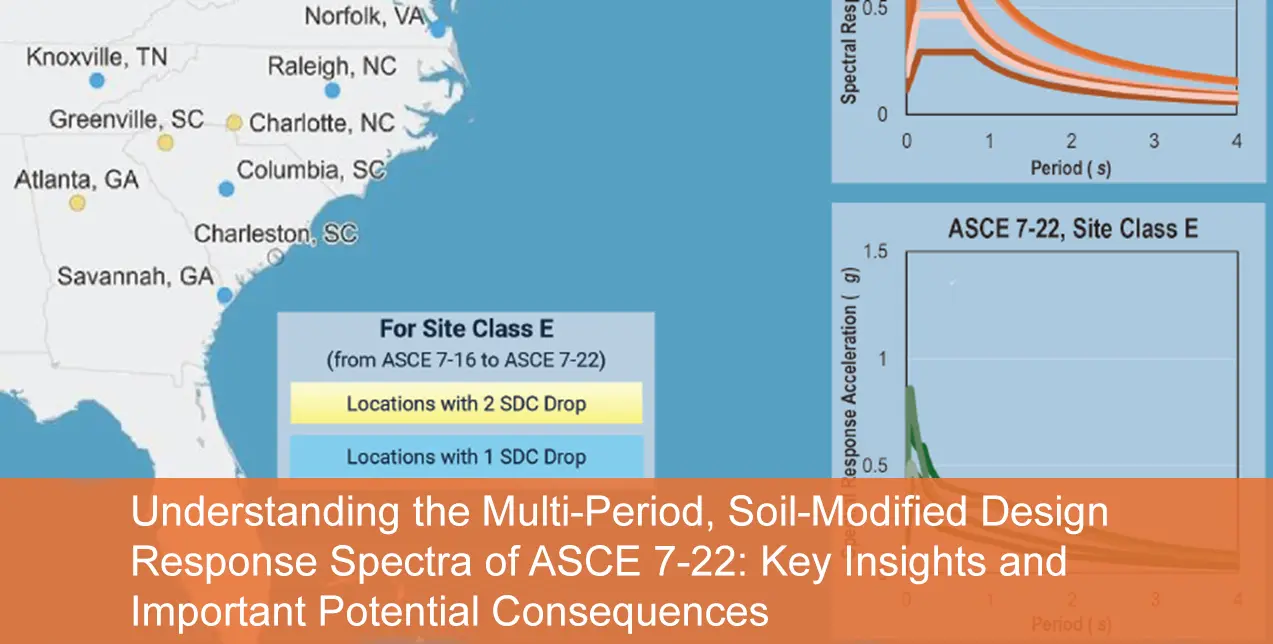
The seismic design landscape in the United States has undergone significant changes with the introduction of the multi-period, soil-modified design response spectra in ASCE 7-22. This new approach, developed by the United States Geological Survey (USGS), represents a change from the traditional two-period spectra used in ASCE 7-16 and prior editions to a more comprehensive multi-period model. While this change aims to improve the accuracy of seismic design, it has raised important questions and concerns, particularly for structures built on soft soils in the Central and Eastern United States (CEUS).
Why Multi-Period Design Spectra?
The traditional two-period design spectra, which relied on spectral response accelerations at 0.2 s and 1.0 s, were found to underestimate the seismic response of long-period structures on soft soils. Recognizing the need for a more accurate prediction of response, ASCE 7-22 introduced multi-period spectra that provide soil-modified spectral response accelerations at multiple periods.
Key Changes in ASCE 7-22
- Shift from SS and S1 to SMS and SM1: In ASCE 7-22, the starting points for seismic design are no longer SS (short-period spectral response acceleration) and S1 (intermediate-period spectral acceleration). Instead, soil-modified values, SMS and SM1, are used. SS and S1 now serve only as triggers for specific ASCE 7 requirements.
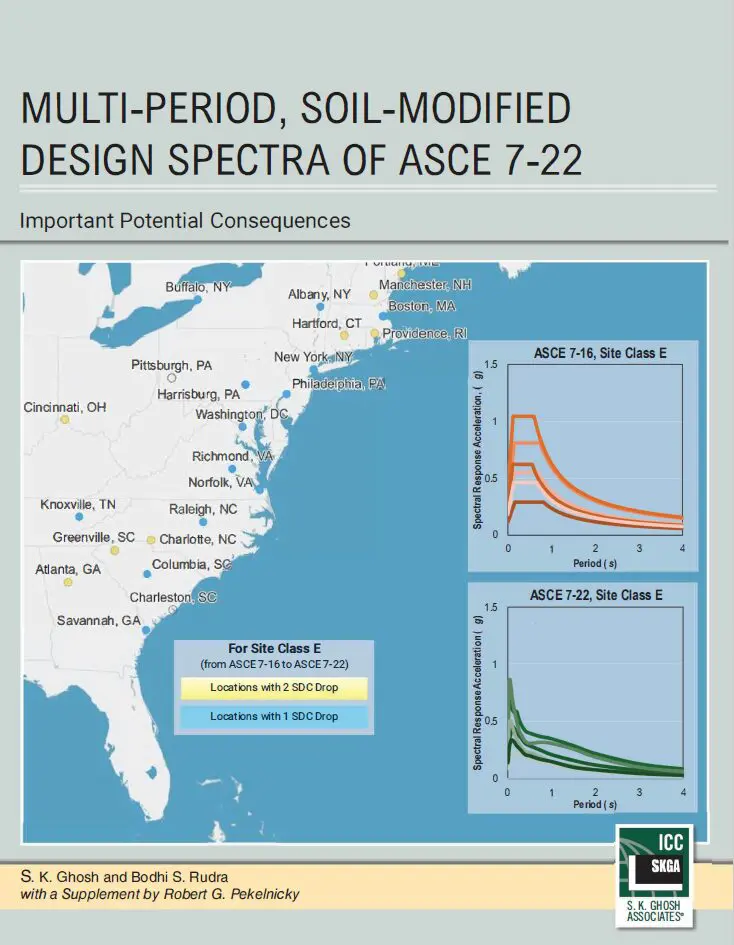
- Elimination of Site Coefficients Fa and Fv: Unlike ASCE 7-16 and prior editions, ASCE 7-22 no longer uses site coefficients Fa and Fv to modify SS and S1. Instead, soil-modified multi-period spectral response acceleration values are directly provided. For CEUS locations on soft soils, these multi‑period design response spectra generally produce lower spectral accelerations than the two‑period spectra used in earlier editions of ASCE 7. Even more notable is the significant difference in the MPRS shape for softer sites—Site Classes DE and E—in the CEUS, where substantial de-amplification of spectral ordinates is observed relative to Site Class D, which is counter-intuitive.
- Impact on Seismic Design Categories (SDCs): As a result of the lower seismic response accelerations, the new multi-period spectra have led to significant changes in SDCs for structures on soft soils in the CEUS. In many cases, SDCs have been lowered, allowing for less stringent detailing requirements and consequently less ductile structures.
Implications for CEUS Locations
The changes in ASCE 7-22 will have a profound impact on seismic design practices in the CEUS. For example, in Savannah, GA, the seismic design category for Risk Category (RC) II buildings on Site Class E soils dropped from SDC D under ASCE 7-16 to SDC C under ASCE 7-22. This shift means that buildings designed under ASCE 7-22 would require less stringent detailing than when designed by past editions of ASCE 7. For many other locations in the CEUS, the SDC for RC II structures has dropped from ‘D’ in ASCE 7-16 to ‘B’ in ASCE 7-22, which translates into a change from requiring special detailing to requiring only ordinary detailing. Table 1 highlights the drop in SDCs. As mentioned above, in addition to the drop in seismic design categories, seismic response accelerations have also decreased for CEUS locations on soft soils.
Table 1. Seismic design categories of ASCE 7-10, ASCE 7-16, and ASCE 7-22 for RC II structures on Site Classes D and E.
blue highlighting indicates one-SDC drop; yellow highlighting indicates two-SDC drop).
| City | Site Class D| Site Class E |
| ||||||
| ASCE 7-10 |
ASCE 7-16 |
ASCE 7-22 |
ASCE 7-10 |
ASCE 7-16 |
ASCE 7-22 |
ASCE 7-16 based on Sds |
ASCE 7-22 based on Sds |
|
| CEUS Cities | ||||||||
| Albany, NY | B | B | B | C | C | B | B | A |
| Atlanta, GA | C | C | B | D | D | B | B | B |
| Boston, MA | B | B | B | C | C | B | C | B |
| Buffalo, NY | B | B | A | C | B | A | B | A |
| Charleston, SC | D | D | D | D | D | D* | D | C |
| Charlotte, NC | C | B | B | D | D | B | B | B |
| Chicago, IL | B | B | B | C | C | B* | B | A |
| Cincinnati, OH | B | B | B | C | D | B | B | A |
| Columbia, SC | D | C | C | D | D | C | C | B |
| Denver, CO | B | B | A | C | C | B | C | A |
| Greenville, SC | C | C | C | D | D | B | C | B |
| Harrisburg, PA | B | B | A | B | B | A | B | A |
| Hartford, CT | B | B | B | C | C | A | B | A |
| Knoxville, TN | C | D | C | D | D | C | D | B |
| Manchester, NH | B | C | B | C | D | B | D | B |
| Memphis, TN | D | D | D | D | D | D* | D | D |
| New York, NY | B | B | B | C | C | B* | C | B |
| Norfolk, VA | B | A | A | B | B | A | A | A |
| Philadelphia, PA | B | B | A | C | B | A | B | A |
| Pittsburgh, PA | B | B | B | B | B | B | A | A |
| Portland, ME | B | B | B | C | D | B | C | B |
| Providence, RI | B | B | B | C | C | A | B | A |
| Raleigh, NC | B | B | B | C | C | B | B | A |
| Richmond, VA | B | B | B | C | C | B | C | A |
| Savannah, GA | C | C | C | D | D | C | C | B |
| St. Louis, MO | D | D | D | D | D | D* | D | C |
| Washington, DC | B | B | A | B | B | A | B | A |
| WUS Cities | ||||||||
| Las Vegas, NV | D | D | D | D | D | D* | D | D |
| Los Angeles, CA | E | D | D | E | D | D* | D | D |
| Salt Lake City, UT | D | D | D | D | D | D* | D | D |
| San Diego, CA | D | D | D | D | D | D* | D | D |
| San Francisco, CA | D | D | D | D | D | D* | D | D |
| Seattle, WA | D | D | D | D | D | D* | D | D |
*Included in ASCE 7-22 Table C22-3.
Addressing the Concerns
The changes in seismic design categories and seismic design forces have raised concerns among engineers and the code community. To address these issues, the Building Seismic Safety Council (BSSC) Provisions Update Committee (PUC) formed an Expert Group to investigate the discrepancies. The group concluded that the de-amplification of seismic ground motion on soft soils in the CEUS was consistent with the NGA-East ground motion models (Goulet et al., 2018, 2021) but acknowledged that the extrapolation of these models to very soft soils was problematic.
Proposed Corrective Measures
The PUC Expert Group recommended placing a "floor" on design spectral response accelerations for Site Classes DE and E in the CEUS. This adjustment ensures that seismic forces for structures on these soft soils cannot be lower than those for Site Class D. While this correction will increase seismic forces, it will not fully restore them to ASCE 7-16 levels, as the NGA-East models have demonstrated that long-period ground motions are inherently lower in the CEUS compared to the Western United States (WUS). Consequently, the SDCs shown in Table 1 will change only at a few locations.
Looking Ahead
The PUC Expert Group Recommendation would normally have been part of ASCE 7-28. However, the ASCE 7 committee has decided to make it available as Supplement No. 5 to ASCE 7-22, which is currently in final stages of processing. Currently, the most accessible and codified version of the modification being discussed is available as Code Change S102-25, to be found in the 2026 Public Comment Agenda (ICC 2026). The proposed change is intended for inclusion in and is expected to be included in the 2027 IBC. If the 2024 IBC/ASCE 7-22 is adopted by a jurisdiction, it should also adopt the modification proposed in Code Change S102-25.
These proposed modifications aim to strike a balance between scientific accuracy and practical application, ensuring that structures in the CEUS are designed to withstand seismic events without compromising safety.
Conclusion
The introduction of multi-period, soil-modified design response spectra in ASCE 7-22 marks a significant step forward in seismic design. However, the changes have highlighted the need for ongoing evaluation and refinement – particularly for soft soil sites in the CEUS. The proposed corrective measures formulated by the PUC Expert Group offer a path forward, ensuring that structures in these regions are at least protected against the significant de-amplification of spectral response accelerations observed for soft soils. As jurisdictions adopt the 2024 IBC, it is crucial for engineers and code enforcers to stay informed about these developments and advocate for implementation of the recommended modifications.
In case you are facing any difficulties downloading the report contact our office at 847-991-2700. https://shop.skghoshassociates.com/code-support-publications/multi-period-soil-modified-design-spectra-of-asce-7-22-1.html